Better Water. Better Service. Better Home.
40-Gallon vs. 50-Gallon Water Heater: Which Size Fits a Family of Four
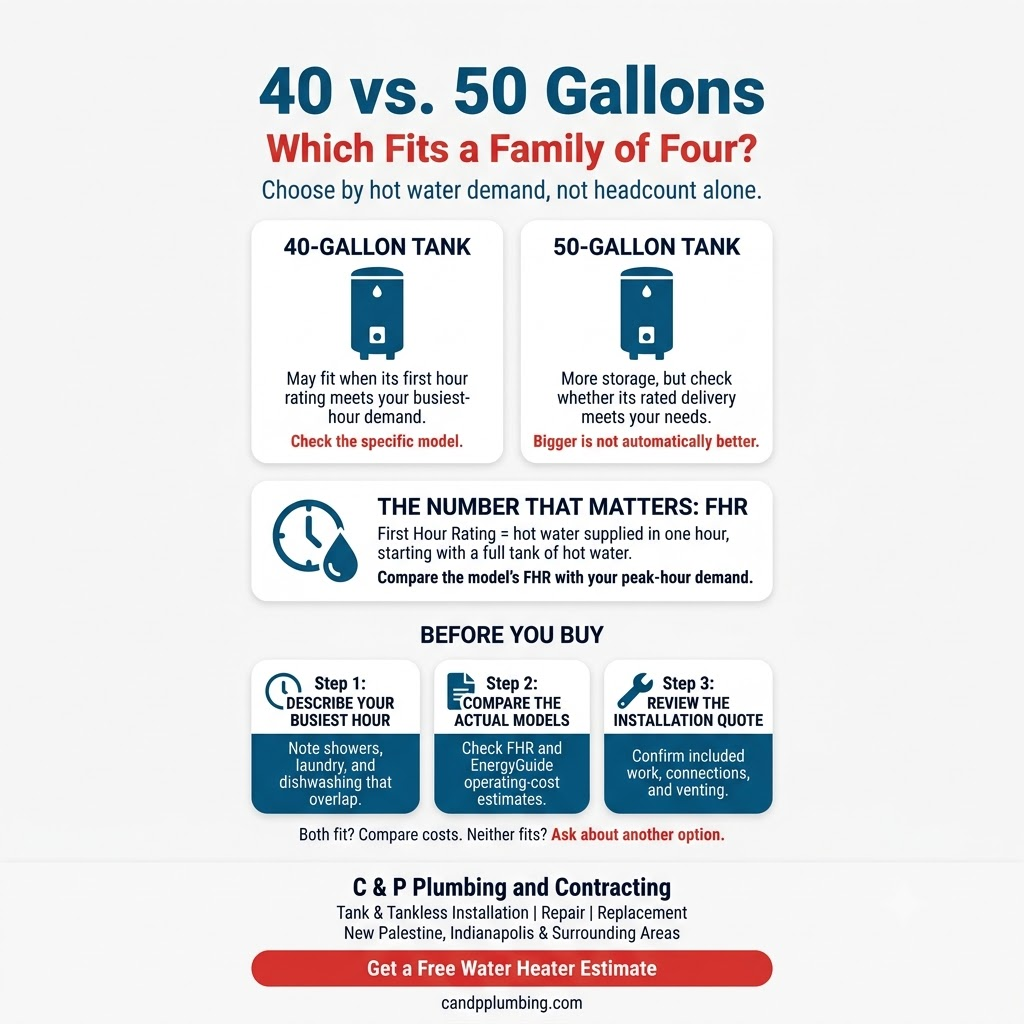
Choosing the right water heater for a family of four depends on your household’s hot water demand, not just the number of people. A 40-gallon model may be sufficient for some families, while others may need a 50-gallon unit to keep up with showers, laundry, and dishwashing.
In this guide, you’ll learn what size water heater a family of four needs, how to compare first-hour ratings, and what to consider before approving a replacement.
Comparing each model’s hot water delivery with your household’s busiest hour helps you choose a suitable system without paying for unnecessary capacity.
Quick Comparison: 40-Gallon vs. 50-Gallon Water Heater
Compare specific equipment rather than relying on gallon labels. Storage capacity and first-hour rating answer different questions.
| Comparison point | 40-gallon candidate | 50-gallon candidate |
| Nominal capacity | 40 gallons | 50 gallons |
| First hour rating | Check the model’s specification. | Check the model’s specification. |
| Family-of-four suitability | Match rated delivery to peak demand. | Match rated delivery to peak demand. |
| Annual operating cost | Compare the EnergyGuide estimate. | Compare the EnergyGuide estimate. |
| Installation requirements | Review model and site requirements. | Review model and site requirements. |
The first-hour rating describes the gallons of hot water a storage heater can supply in an hour, starting with a full tank of hot water, as per the University of Florida IFAS Extension.
What C & P Plumbing and Contracting Does Best
For a family of four, compare the candidate heater’s first hour rating with estimated peak-hour demand rather than selecting by capacity alone. Bring your existing heater’s details and household-use pattern to the estimate so you can discuss whether a particular 40-gallon or 50-gallon model fits your needs.
Sizing by First Hour Rating, Not Tank Size
Before the appointment, describe your busiest hot water period. Note which activities fall within that hour and whether your existing heater normally keeps up.
For example, explain whether several showers happen close together and whether laundry or dishwashing overlaps. You are preparing information for the installer, not performing a complete sizing calculation yourself.
Ask the contractor to identify the candidate models and explain their ratings. The useful question is, “Why does this model’s delivery match our demand?” Avoid assuming that every contractor follows an identical assessment process.
C & P Plumbing and Contracting provides tank and tankless water heater installation, repair, and replacement. Customer Craig Marolf described his replacement appointment:
“It was terrific for Steve to be available on short notice to replace our hot water heater! Steve is courteous, and I’ve already recommended him to a relative in the area.” – Craig Marolf, Google reviewer
That account describes one customer’s experience, not a guarantee of immediate availability.
Choosing a Licensed and Insured Local Plumber
Ask about licensing and insurance when evaluating an installation provider. Keep the installation requirements in the discussion alongside the equipment.
For a gas heater, ask about connections and venting rather than treating the tank as the entire job. C & P Plumbing and Contracting provides installation services that include gas line connections and proper venting.
Ask which tasks your estimate includes and whether any site-specific work affects the proposal. A clear scope helps you compare installation offers, not just equipment prices.
Comparing Transparent, Flexible Pricing
C & P Plumbing and Contracting offers on-site assessments with upfront pricing and flexible pricing.
Before comparing totals, check whether the proposals specify equivalent equipment and work. A different model or scope can explain a price difference. Ask for clarification before treating the lower total as an equivalent offer.
Discuss the model, included installation work, and price together. That gives you a clearer basis for deciding which proposal fits your household.
What Size Charts and Headcount Rules Offer
A household-size chart gives you a starting point, not a completed equipment assessment. Use it to narrow your questions before discussing actual models.
Charts organize choices around the number of residents. However, that number does not identify your busiest hour, the proposed heater’s rated delivery, or your home’s installation requirements.
Move beyond the chart by asking the installer to explain the candidate’s performance. If the recommendation changes from 40 to 50 gallons, ask what household need or equipment specification supports that change.
Also explain whether your existing heater satisfied the family before its current problems began. That history gives the conversation context, but it does not replace an assessment of the replacement model.
The Key Differences That Matter for Your Family
The most useful comparison separates storage, busy-hour delivery, and total ownership cost. Avoid treating any one number as the complete answer.
Tank Size vs. First Hour Rating
A 50-gallon tank has more nominal storage, but the first-hour rating addresses delivery during a busy hour.
For a tank-style heater, the recommended first hour rating should match within 1 to 2 gallons of estimated peak-hour demand, as per the University of Florida IFAS Extension.
For a hypothetical example, compare two proposed models against the same professionally estimated peak-hour demand. If the smaller candidate meets that demand, the larger capacity does not automatically establish a better fit. If it falls short, ask whether the larger candidate’s actual rating resolves the gap.
This comparison depends on the specific equipment, not a universal gallon allowance for four people.
Purchase Price vs. Operating and Installation Costs
The equipment price matters, but the complete decision also includes installation, maintenance, and operation.
Compare the proposed models’ EnergyGuide operating-cost estimates, then ask which installation tasks each proposal includes. The label provides an estimate, not a guarantee of your actual household bill.
Compare the purchase price with lifetime maintenance and operating costs rather than treating the upfront price as the entire cost, University of Florida IFAS Extension.
Which Option Is Best for You?
Choose the model that matches your household’s demand and installation requirements, not a size that supposedly fits every four-person family.
A 40-gallon candidate best suits a household when its rated delivery covers the busiest hour. A 50-gallon candidate better suits that household when its performance covers needs the smaller candidate cannot.
If both meet demand, compare operating-cost estimates and installation proposals. If neither meets demand, ask the installer to explain another suitable option.
A professional estimate helps turn the capacity question into a specific equipment decision rather than a guess from headcount alone.
Frequently Asked Questions
These answers help you prepare for a replacement estimate without choosing a tank prematurely.
Q1. Is a 50-gallon water heater enough for a family of four?
A 50-gallon water heater may meet a family of four’s needs, but capacity alone cannot confirm that. Compare its first-hour rating with estimated peak-hour demand. Ask your installer to explain the proposed model’s suitability before approving the equipment and installation.
Q2. What is a first-hour rating?
The first-hour rating describes how much hot water a storage heater can supply in an hour when it starts with a full tank of hot water. Check the exact model’s rating, not just its capacity. That distinction helps you compare busy-hour delivery.
Q3. Can I replace my water heater with the same size?
The same capacity may remain suitable, but evaluate the replacement model. Explain whether your existing heater met demand before its problems began.
Q4. Does C & P install both tank and tankless water heaters?
Yes, C & P Plumbing and Contracting installs traditional tank and tankless units. Discuss which option fits your household and installation requirements during the estimate.
Q5. How do I request an on-site assessment from C & P Plumbing and Contracting?
Use the company’s website to request an estimate. Include your existing heater’s details and the hot water concerns you want to address.
Conclusion
Deciding between a 40-gallon vs. 50-gallon water heater starts with your household’s peak hot water demand and the model’s first-hour rating. Before approving a replacement, make sure you understand the recommended capacity, installation requirements, and total cost.
Contact C & P Plumbing and Contracting today for an on-site assessment with upfront pricing for a water heater installation or replacement estimate. Discuss your family’s hot water needs and get professional guidance on choosing the right system for your home.